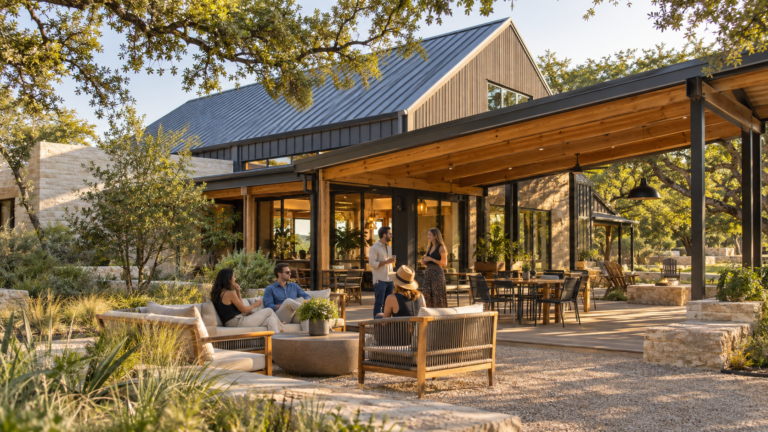
Placemaking in real estate development is the deliberate shaping of how a community looks, sounds, moves and feels, so people experience it as a place they belong instead of a collection of lots and floor plans.
That’s the short version. The longer one takes a bit more explaining, because placemaking lives in the gaps between work a developer is already paying for: land planning, architecture, landscape, branding and sales. Each of those teams does its job well. Placemaking is the work of making sure all of it adds up to something a buyer can feel the moment they turn through the entry.
At L&P Marketing, placemaking isn’t a buzzword we pull out for pitch meetings. It’s a named service line with its own team and its own process, and we’ve used it to help launch some of the best-selling master-planned communities in Texas. So, when a developer asks us, “what is placemaking, and do I need it?” this is the answer we give them.
What Is Placemaking, Really?
The idea goes back to urban thinkers like Jane Jacobs and William H. Whyte, who spent years watching how people used sidewalks, parks and plazas. Their conclusion was simple. People gravitate toward places that feel welcoming, legible and alive, and they avoid places that don’t, no matter how good the renderings looked.
City planners took that idea and ran with it. In a master-planned community, though, the job is a little different. The people you’re designing for haven’t moved in yet. Many of them have never heard of the community. You’re designing for a first impression on a Saturday afternoon, and for what it feels like to live there ten years later.
In practical terms, placemaking answers questions like these:
- What does a buyer see first when they exit the highway?
- Do they know where to go next without pulling up a map?
- When they step out of the car at the welcome center, what do they hear, smell and see?
- Does the amenity center feel like the heart of the neighborhood or an afterthought behind the pool?
- Will residents still feel the same way about the place once the sales trailer is gone?
There’s a line on our placemaking page that sums it up better than any definition: “We can all think of a place that feels like home, and the sights, sounds and even tastes associated with it.” That feeling is the product. Everything else is how you get there.
Why Placemaking Matters for Lot Sales
Here’s the business case. Drive through any growth corridor in Houston, Austin or Dallas and you’ll find several master-planned communities within a few miles of each other. Similar price points. Many of the same builders. A resort-style pool, a trail system and a dog park in almost everyone.
When the spec sheets look alike, buyers decide based on how a place makes them feel. That’s where placemaking in real estate development earns its keep. It gives your community a reason to be remembered after a family has toured four others that weekend, and it gives your sales team a story they can walk people through instead of a list of features.
It also saves money. Catching a wayfinding problem or a clumsy welcome center layout at the charrette stage costs a conversation. Catching it after grand opening costs a redesign, a reprint and some lost traffic.
The Disciplines Behind Placemaking at L&P
One reason placemaking gets fuzzy is that nobody breaks it into parts. We do, because developers need something they can scope, schedule and budget. At L&P, placemaking in real estate development covers these disciplines:
Charrette coordination. We help run the early design sessions where planners, architects, builders and the developer hash out the vision. Our role is to keep the end experience in the room, so decisions about streets, lots and amenities get tested against how people will use them.
Critical path audit and development. Placemaking only works if things open in the right order. We map the timeline so the entry, signage, welcome center and first amenities are ready when buyers start showing up, not three months after.
Welcome and sales centers. This is often the first room a buyer walks into, and it sets the tone for everything after. We help shape the layout, flow and feel so it reads less like a sales office and more like the best version of the neighborhood.
Wayfinding signage programs. Signs do more work than most people give them credit for. A good program guides visitors, reinforces the brand and makes a large community feel easy to understand. We wrote more about this in why community signage matters.
Amenity consultation. We weigh in on which amenities fit the buyer profile, where they sit in the plan and how they’ll be programmed, so they become gathering spots and not just line items in a brochure.
Experiential ideation and sensory experience. This is where we think through the details that people notice without realizing it: music at the welcome center, landscaping at eye level, lighting at dusk, even what visitors taste and smell when they arrive. Small cues, big effect.
Onsite experience consultation. Once things are built, we walk the property the way a buyer would and fix what feels off. Sometimes that’s a confusing turn. Sometimes it’s a view that should be framed and isn’t.
Marketing to sales team coordination. The experience online should match the experience on site. We make sure the story in your ads, website and social channels is the same one your sales team tells at the front desk.
Placemaking vs. Architecture vs. Brand Identity
After “what is placemaking,” this is the question we hear most. All three disciplines shape how a community is perceived, and they overlap on purpose. The difference is in which decisions each one owns.
| Placemaking | Architecture and Landscape Architecture | Brand Identity | |
| Core question | How will people experience this place? | What gets built, and how does it work? | How does the community present itself? |
| Usually owned by | Placemaking consultant, working with the developer | Architects, landscape architects and land planners | Branding or marketing agency |
| Decisions it owns | Arrival sequence, welcome center flow, wayfinding strategy, amenity programming, sensory details, event and activation plans | Building design, site layout, materials, plant palette, grading and engineering | Name, logo, color palette, voice, photography style, brand standards |
| Typical deliverables | Experience plan, signage program, sales center concept, critical path timeline | Site plans, construction documents, landscape plans | Logo suite, brand guidelines, messaging framework |
| When it starts | Concept and charrette stage | Land planning and design development | Before any public-facing marketing |
| How success shows up | Traffic, time on site, sales conversations, resident engagement | Function, code compliance, durability, cost | Recognition, consistency, lead quality |
The trouble usually isn’t overlap. It’s the seams nobody owns. The landscape architect picks one stone for the entry monument, the brand guide calls for a different color story, and the builder’s sales office has its own look entirely. Buyers feel that disconnect even if they couldn’t explain it. Placemaking is the discipline that owns those seams.
What Does a Placemaking Consultant Do?
A placemaking consultant is the person whose job is to protect the end experience across every phase. Our placemaking page describes it as working “from concept to grand opening and beyond,” and that’s accurate. Here’s roughly what that looks like:
- Before groundbreaking: join the charrette, define who the buyer is and how the community should feel, and build the critical path.
- During design: review site plans, entry concepts and amenity layouts through the lens of the visitor and develop the wayfinding program.
- Before opening: shape the welcome center experience, coordinate marketing with the sales team, and plan the grand opening.
- After opening: walk the site, watch how people use it, and adjust signage, programming and onsite details as the community grows.
The value of placemaking in real estate development is that one partner is looking at the whole picture while everyone else is, rightly, focused on their piece of it.
Two L&P Projects Where Placemaking Did the Heavy Lifting
The Grove, Austin: A Welcome Center That Didn’t Feel Like a Sales Office
The problem: Milestone Community Builders needed The Grove to stand out as a mixed-use development in one of the most competitive markets in Texas, and it needed to make that impression before model homes were open.
What we did: Instead of a traditional sales space, we created a welcome center built for discovery. Bar-height seating and an open layout made it feel more like a neighborhood hangout than a closing table. Generous outdoor seating sat under barn and shed roof elements. Interactive digital displays let visitors explore the full vision for homes, retail, office space and green space, and a secluded meeting room gave the sales team a quiet place for serious conversations.
The result: The Grove booked more than 100 reservations during pre-sales events and closed 41 sales within 30 days of those events. The welcome center put the community on the map before a single model home opened its doors.
Santa Rita Ranch, Austin Area: Selling a Culture Before It Existed
The problem: Santa Rita Ranch had to sell a lifestyle and a community culture to buyers before most of the community had been built. There was nothing yet to tour, so people needed a reason to believe in it.
What we did: We started with “The Ranch Code,” a set of shared community values that gave every touchpoint a common voice. We consulted on the design of the Ranch’s multiple welcome centers so each one delivered that same feeling in person, and we built realtor relations events that brought the culture to life for the agents bringing buyers through.
The result: Santa Rita Ranch became the top-selling master-planned community in the Austin area and has been honored by the Home Builders Association as a three-time Developer of the Year and three-time Community of the Year. Marketing efforts have been tied to more than $173 million in sales.
You can see more of this work on our projects page.
How Placemaking Fits into Your Marketing Plan
Placemaking and marketing feed each other. A well-designed arrival gives your photographers something worth shooting. A busy amenity calendar gives your social team something real to post. A welcome center with a clear story turns website leads into appointments that close.
That’s why we treat placemaking in real estate development as part of a full marketing plan rather than a separate project. If you’re mapping out the bigger picture, our guide on how to market a master-planned community walks through how each channel fits together by development phase.
Quick Answers
What is placemaking?
Placemaking is the practice of shaping how a place looks, feels and functions so people want to spend time there. In a master-planned community, it shapes the full buyer and resident experience, from the entry drive to the amenity center.
What does a placemaking consultant do?
A placemaking consultant protects the end experience from concept through grand opening. That includes charrette coordination, welcome and sales center planning, wayfinding programs, amenity consultation and onsite experience reviews.
Is placemaking the same as landscape architecture?
No. Landscape architects design and engineer the outdoor spaces. Placemaking decides how those spaces should be experienced and makes sure they line up with the brand, the signage and the sales process.
When should a developer bring in placemaking?
As early as the charrette stage. Experience decisions are cheapest to make before the site plan is locked.
Let’s Build a Place People Remember
The communities people love rarely to get that way by accident. Someone made a lot of small, careful decisions about how it would feel to arrive, explore and eventually come home there.
That’s the work we love doing at L&P. If you’re planning a new community or want a fresh set of eyes on one that’s already selling, look at our placemaking services or give our Houston team a call at 713.397.0610. We’d love to hear what you’re building.